3 Tips for Writing Federal Grant Proposals
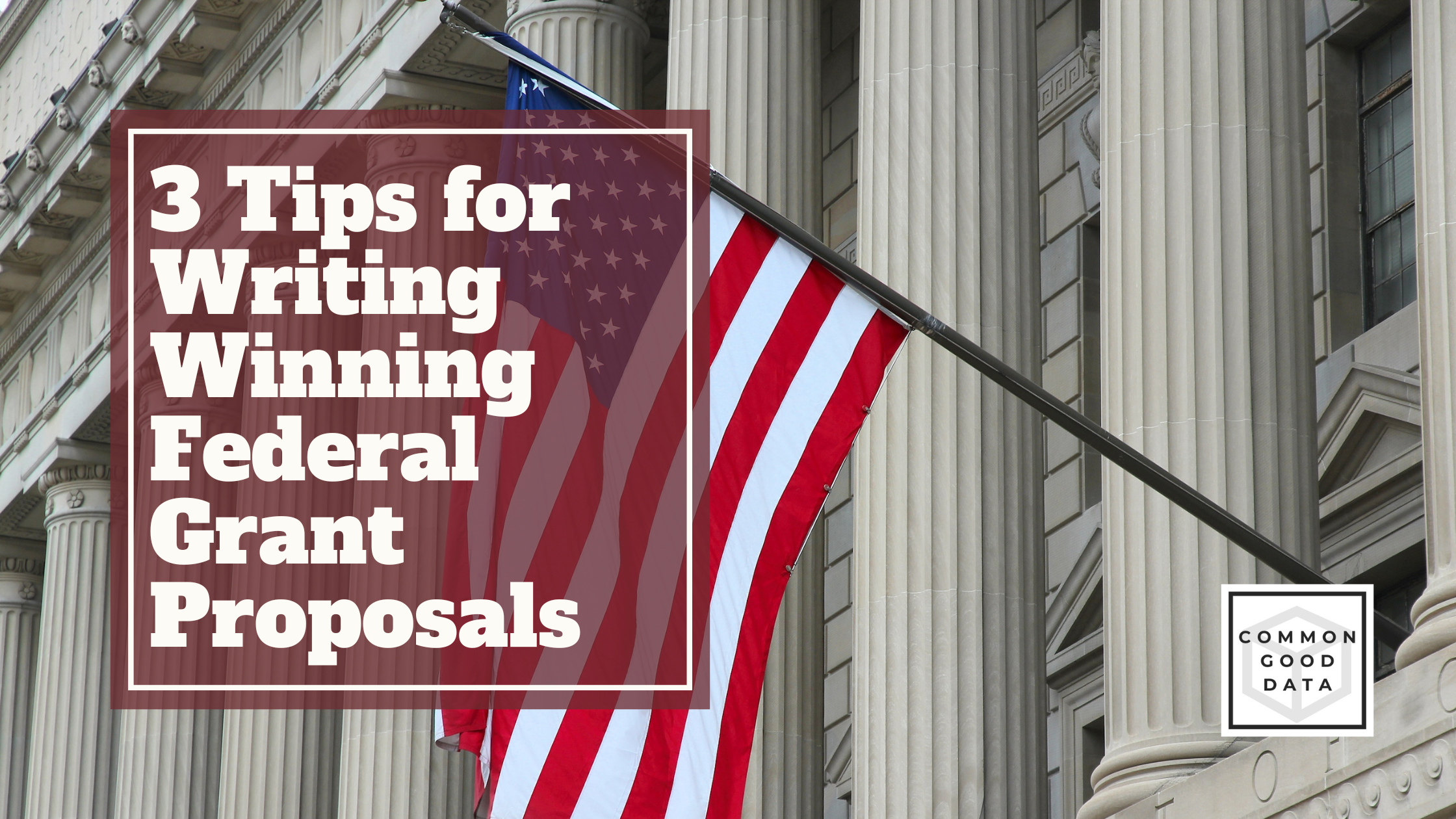
It’s the start of the new year, and for many organizations it marks the start of federal grant writing season.
Federal grants bring stability and predictability to the bottom line with high-dollar, multi-year contracts and support for in-kind expenses. They’re very competitive, but can provide the kinds of consistent resources your organization needs to offer high-quality programs and services over the long-term.
As a data and evaluation consultant, I've worked with a number of teams to win six-figure, 4-5 year grant awards in the areas of mental health and substance use prevention using proven grant-writing processes designed to help organizations write successful proposals.
But not all proposals win. Below are the three main weaknesses I see with grant proposals, and how you can avoid them.
1. The proposal lacks alignment.
The #1 problem with most federal grants is lack of alignment between the project narrative, goals and outcomes, evaluation section, and budget.
I get it - federal grants are an enormous undertaking, and many teams will break up the work and sections among different staff members to get the job done. Your programs folks write narratives and goals, the finance person writes the budget, and if you're lucky, you have someone with evaluation expertise to talk about how you'll show impact.
But there's a problem: everyone writes a section, but they aren't linked. For example:
Funds are budgeted for staff and programs that are not linked with your primary goal(s).
Project narratives focus too much on what you do without taking into consideration the purpose of the actual NOFO (Notice of Funding Opportunity).
Partnerships are proposed but lack clarity on which organization is actually doing what, and who will be accountable.
Evidence-based programs are proposed but don't actually solve the specific problem intended by the NOFO.
The evaluation plan doesn't actually measure the proposed project's goals and outcomes.
Sound familiar?
Alignment Solutions
To write your aligned and winning proposal, make sure that you:
Meet as a team early in the process. The first couple weeks of December/January is a good time to have a kick-off meeting to bring your team together, assign roles, and most importantly, identify the leader of your project who will be responsible for making sure all the pieces fit together. In many nonprofit settings, this person is the Executive Director, but it can be anyone. Make sure you have a trusted person who really understands programs, finances, and evaluation to review the grant in its entirety.
Develop an outcomes worksheet to guide your thinking. Many grants have some version of this in the NOFO, but it's important to have some kind of chart, table, or visual diagram that links your goals to activities to outcomes. Sometimes, this looks like a logic model or theory of change.
Make sure every member of the team reads the NOFO. I can't tell you how many times I've been on a team where it's obvious not everyone has read the NOFO - and it leads to all kinds of problems as proposed ideas are discussed that have nothing to do with the project. Success comes to those who do their homework - so get started early.
Begin with the end in mind. So many organizations begin grant planning sessions by asking "what can we fund with this money?" when in fact what they need to ask is, "when this grant is completed in 5 years, what will the clients and communities we serve have achieved?" Always start with the end in mind, setting clearly defined goals and linking them to measurable outcomes. Then, as you write budget, narrative, and evaluation sections, ask yourself, "Is XXX going to help us achieve our goals?" If not, delete it and replace it with something that will.
2. The proposal is not feasible.
Winning proposals are awarded to the organizations that provide the best evidence that they have the experience, capacity, and skillsets needed to actually accomplish the project goals.
We all love new and innovative ideas - and there is a place in the grant writing process for generating ideas that will position your organization as the vanguard of new ideas in the social sector. But many organizations will propose ideas that are clearly set up to fail from the start because they did not provide any evidence that they have the pieces in place to actually accomplish them.
Remember, it's not just what you claim to accomplish, but making the case that you have the ability to accomplish it. Process is just as important as outcomes. Make sure to only state what you can realistically accomplish in 3-5 years that conveys self-knowledge of your own strengths and limitations as an organization.
Feasibility Solutions
Identify strong partners early in the grant writing process, and collaborate with them in writing the grant. I can't tell you how many times I've had conversations about partnering with another organization in the community to offer a new program or service - two days before the grant is due. Do not scramble for MOUs and agreements in the last week of the proposal writing process. Do not propose complex partnerships with organizations that you've never worked with before. It will be obvious that the proposed partnership is weak to the reader. And even if you do somehow win the award, you'll run into a host of implementation problems when you try to run the partnership when all you have to go off of is a hastily written MOU.
Build a diverse team before applying for the grant. Many organizations will write narratives about serving the "XXX population" but will have no meaningful experience actually working with culturally and linguistically diverse groups named in the proposal. You need to have members of your team who have demonstrated experience working in the contexts that you are proposing on the grant - and if you don't, wait a year and build them first. Don't waste your time writing a grant you won't win because your team hasn't done the work ahead of time to do the work well.
Plan for and write-in capacity needs. A strong organizational leader like the Executive Director should be able to allocate sources appropriately for staffing and administrative needs. Make sure you take some resources to cover the work of administering the program - not just delivering the services. And build in resources for program materials, technology, participant incentives, evaluation work, and other capacity needs.
Don't overpromise. It is tempting to write in lofty goals and propose big changes in outcomes in an attempt to win over your readers. However, most grant reviewers will see through what you're doing, or worse, they won't, but when it comes to actually implementing the grant you will spend the entire grant period trying to accomplish goals you could never achieve. I've seen organizations have funds removed or "clawed back" because they overpromised on what they could accomplish when writing the grant proposal. Be sure to ask yourself the hard questions when writing your proposals - can you really serve that many people? Will you really see that big of a change in your outcomes? Is your program really going to be ready to intake clients two days after the grant is awarded? Look for the fail points early in the proposal writing process and take out a red pen to fix them prior to hitting submit.
3. The evaluation isn't rigorous.
One of the most challenging sections to write in federal grant proposals is the evaluation section. Many organizations do not have someone on their staff who has strong evaluation experience and as a consequence save leave this forgotten section for last.
Trust me, it shows.
But the evaluation section is also the area where you have one of the best chances to distinguish your project from everyone else's, because so few organizations have robust capacity for data and evaluation. Drafting a good evaluation design before the project begins will save you time and just might be the difference for your grant proposal.
Evaluation solutions
Every goal must have a measurable outcome, and every outcome must have a plan for collecting the data to measure it. This seems obvious, but I have seen many proposals that have lofty goals without any clear process for measuring them. The evaluation section is not a place to write about how your impact "goes beyond numbers" and people's successes "can't be reduced to a datapoint." If you do, your proposal will be dead on arrival. Everything you propose to accomplish must be measured, and if you can't measure it, then it shouldn't be a goal.
Collecting data is always harder than you think. Remember, most people won't complete your surveys, won't participate in your focus groups and interviews, and will be annoyed or skeptical when you ask them to share information about themselves with you. Be realistic about how many people you think will participate in the evaluation work, and build in incentives and other strategies to increase participation in data collection efforts.
Remember legal and ethical considerations. Gathering and reporting on data is a sensitive matter that requires extraordinary caution and care. Be sure to be familiar with local, state, and federal laws (e.g. HIPAA, FERPA, COPPA, and others) that impact how you collect and use client information. Your evaluation should meet the standards of ethical research and evaluation principles (e.g. informed consent), and you may consider having your project reviewed by an Institutional Review Board.
Build a team with expertise. Evaluation is more than just drafting a google survey. Be sure to work with a trusted expert who has a clear record of success in evaluating projects like yours. If you have someone internally, bring them into the evaluation process early. If you need to hire/contract someone externally, begin the conversation before you hit submit on the proposal.
Ready to get started?
Now is the time for starting over fresh and setting goals - the perfect time to start your next federal grant.
Apply for a grant at grants.gov
Review SAMHSA's documentation on competitive grants proposals.
Check out the Community Toolbox's resource on getting grants and financial resources.
Looking for some external expertise? I've worked with organizations to apply for local, state, and federal grants to win multi-year awards. Visit our Contact page to set up a consultation to improve your grant writing with an excellent evaluation section to win your next federal grant.