The Common Good Data Blog

Insight and mistakes from the world of program evaluation

Good Work Deserves to Be Seen: The Case for Louder Dissemination in Public Health
Internal reports, PDF’s, academic conferences… this is where so many public health organizations lose their audience and more importantly, miss the opportunity to share their impact. At a time when public health work is so undervalued and unappreciated, public health organizations need to be louder, direct, and at the forefront of their dissemination.
We need to explicitly connect the dots between program and impact, and easy quantify how your organization’s work has improved lives within the community.
But how do health organizations make this connection? Through robust and sustainable evaluation frameworks.
How Integrating Costs into Your Evaluation Generates Funding Opportunity: The Case of Naloxone
In public health evaluation, it is common to translate program outcomes into cost-effectiveness metrics. The goal is not to place a value on human life, but rather to illustrate how relatively modest investments in prevention can generate substantial, life-saving impact.
Consider a naloxone distribution program.
Imagine a program distributes 10,000 naloxone kits in a year. To make the math simple, assume each kit costs $50. That means the direct supply cost is:
Beyond Good Intentions: Protecting Funding Through Defensible Impact
Most behavioral health programs are doing meaningful work. They are serving individuals in crisis, coordinating care, building coalitions, and responding to evolving federal and state requirements. The commitment is real, and the impact on communities is significant.
Yet many program leaders quietly feel vulnerable as grant terms approach their end. Not because the work is weak, but because sustaining it often requires securing new funding. When a federal award sunsets, the question becomes whether the program can compete effectively for the next opportunity, whether from the same agency or a different source altogether.
Three Steps to Thrive as a Nonprofit
Many nonprofit leaders know what it feels like to be constantly running on empty. The pressure to do more with less. The uncertainty of whether the next grant will come through. The feeling that your organization is always one budget cycle away from falling behind.
This reality is known as the nonprofit starvation cycle. It’s what happens when organizations focus so heavily on survival that they lose sight of strategy. It leads to burnout, limited capacity, and a constant sense of scarcity.
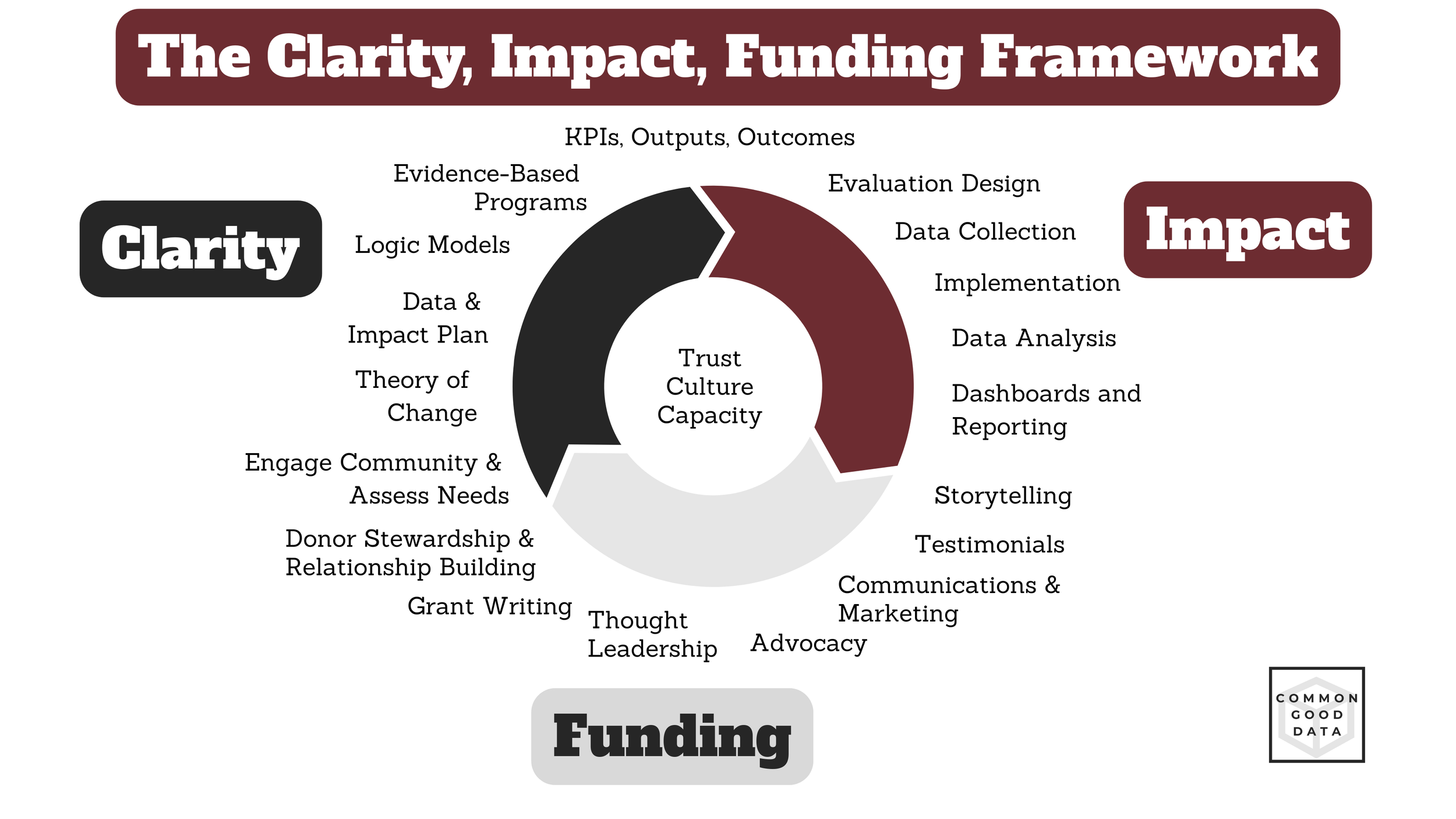
At Common Good Data, we believe the solution isn’t to work harder — it’s to work smarter. Thriving nonprofits are guided by three essential elements: Clarity, Impact, and Funding. Together, they form what we call the CIF Framework — a simple model that helps organizations grow with confidence and purpose.
Breaking the Starvation Cycle: Why Nonprofits Need Data Strategy
If you’ve ever felt like you’re stuck in a cycle of scrambling for funding, worrying about payroll, and trying to do more with less, you’re not alone. Many nonprofit and public sector leaders face the relentless pressure of what’s called the nonprofit starvation cycle. It’s the reality of being asked to deliver big impact with limited resources, often under the weight of funder expectations to keep “overhead” low. The result is a scarcity mindset that keeps organizations in survival mode rather than thriving.
The danger of a scarcity mindset is that it convinces leaders they can never invest in the very things that would strengthen their organization — staff, systems, and strategy. Every week feels urgent, and long-term planning feels out of reach.

3 Traits of Impactful Nonprofit Leaders
How do you maintain an impact mindset when planning programs and activities at your nonprofit? In this blog post, Drew discusses the risks of being focused on novelty over impact. He then shares three traits of impact-focused leaders, including:
Impactful leaders know: It’s not about them.
Impactful leaders have a north star.
Impactful leaders align what they’re good at with what the community needs.