
There’s a great lesson to learn from Little League baseball: don’t swing at the first pitch.
Baseball is a slow, and honestly, kind of a boring game. So it makes sense when a player goes up to bat and wants to swing at that first pitch. To be a hero, hit that home run, and round the bases in all their glory.
Over the years, I’ve worked with many organizations trying to address complex social problems. Some have been remarkably successful, while others have struggled despite having experienced staff, adequate funding, and well-designed programs. When I think about the initiatives that haven’t gone as planned, I often come back to a common problem: organizations can be so eager to get started that they move into action before they’ve built the relationships needed to make their work successful.
Organizations that go straight into action are kind of like that little league player who swings at the first pitch. Maybe they received funding to address substance use, improve community health, or support families, and the expectations are mounting. Staff need to be hired, activities need to be implemented, and outcomes need to be reported. Funders want to see progress, and organizations understandably want to demonstrate that they’re making good use of their resources. Under those circumstances, spending six months building relationships can feel like a luxury.

A little league baseball player waits for the pitch. Photo provided by Unsplash.
So can waiting into the pitch count.
In baseball, taking the first pitch is a good strategy because it keeps you from swinging at a potentially bad ball. It also forces the pitcher to throw more pitches, so they can get worn out and have to leave the game. Taking a pitch can calm your nerves, it can help you read the pitcher, it can help you to see what’s coming. And it forces you to stay disciplined. You’re letting a potential great pitch pass you by because you have a longer strategy in mind.
Good community-based work requires this kind of discipline and patience. Communities have their own histories, relationships, priorities, and ways of understanding the problems they face. An intervention that makes perfect sense to the professionals designing it may look quite different to the people being asked to participate. And even when an organization has identified a genuine need, it may lack the relationships and credibility required to address it effectively.
In baseball, patience at the plate gives you a better chance of getting on base. In community work, patience gives you a better chance of understanding what people actually need. And perhaps more importantly, it gives the people you’re hoping to work with a reason to believe that you think their perspectives matter. Your patience communicates that you’re willing to listen before deciding what to do.
Patience is the first step in the road to trust and relationship, which is at the core of all community work.
The relationships that make community work possible
I once worked with an organization implementing a prevention initiative in a community here in the Southeast. The organization had committed staff and a clear programmatic approach, but its initial efforts to engage families were challenging. Much of the work was being directed by professionals, and building relationships with parents and community members was taking longer than anticipated.
Over time, the organization began shifting toward a more parent-driven and community-led approach. Parents and other community members assumed greater responsibility for outreach, recruitment, and engagement. They brought relationships with neighbors, schools, churches, and informal networks that professional staff simply didn’t have. They also understood how people communicated within the community, which messengers were credible, and what kinds of conversations would resonate with families.
That shift helped the organization reach people it had previously struggled to engage. What interests me about this example is that the improvement wasn’t primarily the result of a new curriculum, a new technology tool, or a more sophisticated outreach strategy. The organization became more effective when it recognized and drew upon relationships that already existed in the community.
Political scientist Robert Putnam’s work on social capital provides a useful framework for understanding why this matters. In Bowling Alone, Putnam explores how social networks, norms of reciprocity, and trust contribute to collective action. His work distinguishes between bonding social capital, which connects people within relatively close social networks, and bridging social capital, which connects people across different groups and institutions.
Both forms of social capital are important in community initiatives. Bonding relationships can create the familiarity and credibility that make people willing to participate in a program. Bridging relationships can connect those existing networks to new resources, opportunities, and institutions. In the prevention initiative I described, parents brought strong relationships within their community, while the organization helped connect those relationships to prevention resources and programming.
The larger lesson is that communities often possess considerable social capital before an organization ever arrives. The challenge for outside institutions is recognizing that social capital and finding ways to support it without attempting to control or replace it. This requires some humility, particularly among professionals who are accustomed to being responsible for program design and implementation. It also requires patience and time.
Community members may have their own ideas about what the problem is and what the solution should be.
Trust, reciprocity, and the importance of following through
One of the concepts I find most useful when thinking about trust is reciprocity. At its simplest, reciprocity involves mutual expectations and obligations that develop through repeated interactions. I ask something of you, and you follow through. You ask something of me, and I do the same. Over time, those experiences create a basis for believing that the relationship is reliable.
In community work, this means that trust develops through what organizations actually do, rather than what they say about their commitment to engagement. Consider the familiar practice of conducting community listening sessions. An organization invites residents to share their experiences, identify concerns, and suggest possible solutions. Staff take notes, thank everyone for participating, and promise to use the information to inform their planning. But what happens afterward? Do residents ever see the findings? Are they told which recommendations were adopted and which were not? Does anyone explain how their contributions influenced the final decisions?
When organizations fail to close that loop, community engagement can become an extractive process. Residents contribute their time, knowledge, and experience, but the organization retains control over the information and the decisions that follow. Even when this happens unintentionally, it can reinforce skepticism about whether participation is worthwhile.
Reciprocity suggests a different approach. Organizations should be clear about what they’re asking of community members, what participants can expect in return, and how commitments will be honored. That might mean sharing findings back with residents, compensating people for their contributions, providing opportunities for continued involvement, or explaining transparently why certain recommendations cannot be implemented.
It also means accepting that community members have the right to make requests of the organization. Relationships become more meaningful when expectations flow in both directions, rather than treating residents primarily as sources of information, program participants, or beneficiaries of services.
I think this is particularly important in communities that have experienced repeated cycles of outside investment and institutional withdrawal. Residents may have participated in previous initiatives that promised meaningful change but disappeared when funding ended. Their skepticism toward a new program may reflect considerable experience with how these initiatives operate. Building trust in that context requires acknowledging the history and demonstrating, through consistent action, that the current relationship you’re seeking will be different.
Who gets to define the community?
Another experience from my consulting work illustrates how questions of trust can emerge in seemingly small decisions.
I worked with an organization that was beginning a community-based initiative under a name associated with the neighborhood where it intended to operate. The problem was that the organization had chosen an older name for the neighborhood, one that didn’t resonate with how current residents understood and identified their community.
Residents raised the issue early in the process and told the organization’s leadership that the name needed to change before the initiative could move forward.
From an administrative perspective, changing an organization’s name might seem like an unnecessary distraction from the substantive work of addressing community needs. But the disagreement was about more than terminology. It reflected a fundamental question about who had the authority to define the community and represent its identity.
The organization had approached the neighborhood with a particular understanding of its history and identity. Residents had a different understanding, informed by their own experiences and relationships to the place. The request to change the name was an opportunity for the organization to recognize that difference and reconsider an assumption it had made.
I’ve thought about this example often because it illustrates something that can be difficult for professionals to acknowledge: our expertise doesn’t necessarily give us the authority to define someone else’s experience. We may have extensive knowledge of public health, prevention science, community development, or program evaluation, but that knowledge is incomplete without an understanding of how residents perceive their own circumstances.
This tension becomes especially important when organizations begin identifying community needs and designing interventions. Professionals may define a problem using epidemiological data, administrative records, or established research frameworks. Residents may understand the same conditions through the lens of historical experience, cultural identity, economic opportunity, or relationships with local institutions. Neither perspective should be dismissed, but the professional perspective often carries greater institutional authority because it is connected to funding, technical expertise, and formal decision-making structures.
Trust requires organizations to recognize these differences and create opportunities for community members to influence how problems are defined. Otherwise, engagement risks becoming a process of asking residents to validate decisions that have already been made.
Moving from participation to shared power
This brings us to one of the more complicated questions in community engagement: what does it actually mean for a community to participate in an initiative?
While teaching a graduate community practice social work course, I often ask students to name what comes to mind when they think of strategies to engage the community. They often will share things like sharing flyers and information, posting on social media, or tabling at or attending events. I then ask them, “What do these things all have in common?” Most students need to think on it, but eventually we get to the conclusion:
All the traditional ways of engaging the community flow in one direction, usually from an institution or organization with power and resources to a community without those things.
The students then are asked to imagine what community work might look like if it didn’t have that one-direction focus. What would it look like for information and resources to flow in both direction? What would it look like to change who gets to decide?
Two frameworks have been particularly useful in helping me think about these distinctions.
The first is Sherry Arnstein’s Ladder of Citizen Participation, published in 1969. Arnstein described eight levels of participation, ranging from manipulation and therapy through informing, consultation, and placation, and ultimately to partnership, delegated power, and citizen control. Her central argument was that participation should be understood in relation to the distribution of power. Inviting people into a process doesn’t necessarily mean they have meaningful influence over its outcomes.
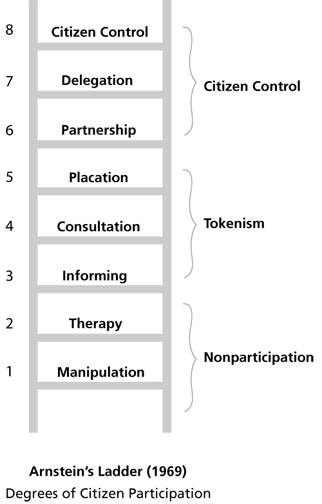
Source: The Citizen’s Handbook
I find this framework especially relevant because organizations can invest considerable energy in engagement activities without changing who makes decisions. A nonprofit might conduct extensive surveys, hold community meetings, and establish an advisory committee while retaining complete authority over program priorities and resource allocation. Those activities may provide useful information, but they don’t necessarily represent shared power.
The second framework is the International Association for Public Participation’s IAP2 Spectrum of Public Participation. It identifies five levels of engagement: Inform, Consult, Involve, Collaborate, and Empower. Each level describes a different degree of public influence and a corresponding commitment from the institution conducting the engagement.
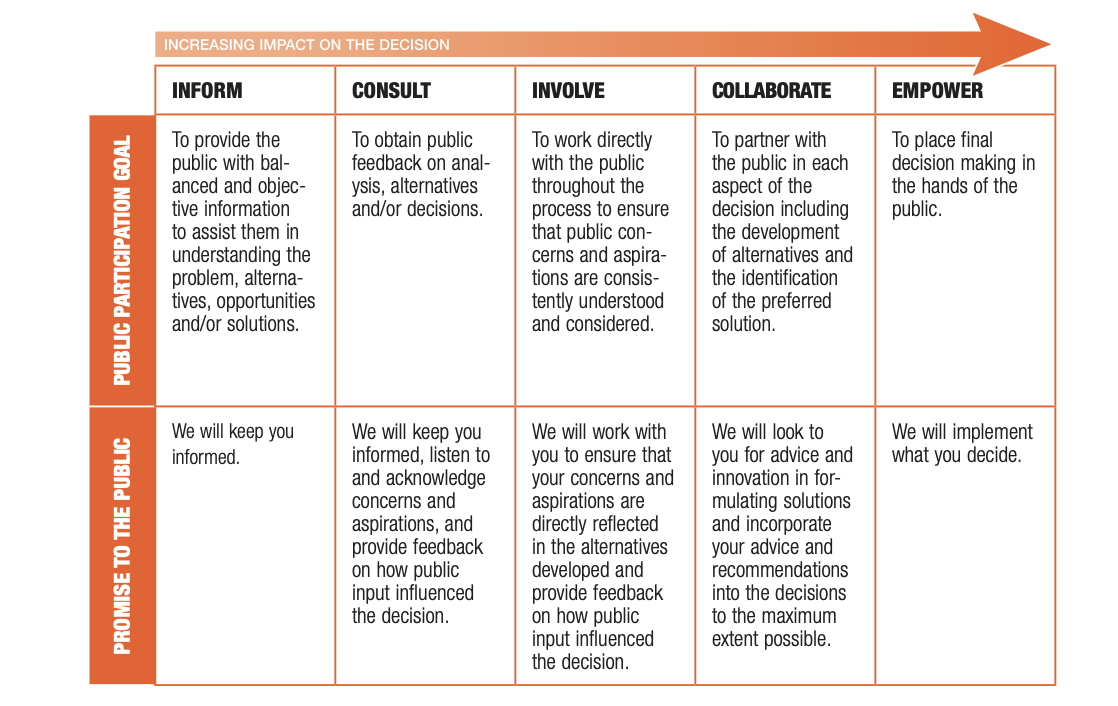
IAP2 Model. Source: iap2.org
One reason I appreciate the IAP2 framework is that it encourages organizations to think deliberately about the kind of participation they’re seeking. There are circumstances where informing residents about a decision is appropriate, just as there are circumstances where consultation or collaboration may be necessary. Other initiatives, particularly those intended to strengthen community ownership and self-determination, may call for residents to hold substantial decision-making authority.
The key is to make these choices consciously and communicate them honestly. If an organization is seeking feedback but will retain final decision-making authority, it should be transparent about that arrangement. If it promises collaboration, community members should have meaningful opportunities to influence the direction of the work. And if it commits to community empowerment, that commitment should be reflected in actual governance and decision-making structures.
Arnstein and IAP2 approach participation from somewhat different perspectives. Arnstein’s framework is particularly useful for questioning institutional power, while IAP2 provides a practical structure for designing engagement processes. But they both offer a way to move beyond vague commitments to community involvement and examine what participation actually means.
For organizations that want to take community leadership seriously, these questions should extend into governance. Consider a nonprofit whose mission is to improve conditions in a particular neighborhood. How many members of its board live in that neighborhood? Who determines its strategic priorities? Who decides how resources are allocated? Who has the authority to change course when residents disagree with the organization’s direction?
One approach is to create governance structures in which residents or members of the population served hold a majority of board seats. Other possibilities include resident-led steering committees, participatory budgeting processes, or community advisory bodies with clearly defined authority over particular decisions. Task forces, committees, and coalitions also fall in this camp.
Of course, representation alone doesn’t guarantee meaningful participation. Organizations also need to consider whether community members have access to the information, resources, and practical support necessary to participate effectively. Meeting schedules, language access, childcare, transportation, compensation, and the ability to shape meeting agendas can all influence whose voices are heard.
There is also no single governance arrangement that will be appropriate for every initiative. Public agencies and nonprofits operate within legal, financial, and administrative constraints that shape how decisions can be delegated. Nevertheless, those constraints shouldn’t become a convenient explanation for maintaining institutional control over every aspect of the work.
Put another way: the question we should ask ourselves is how organizations can share as much meaningful authority as possible while remaining accountable for their responsibilities.
Community work moves at the speed of trust
Stephen M. R. Covey’s The Speed of Trust explores how trust influences organizational effectiveness and the costs associated with low-trust relationships. Although the book focuses heavily on organizational and business contexts, I think its central insight applies directly to community initiatives.
When trust is limited, nearly every aspect of implementation becomes more difficult. Recruitment requires more effort because residents are unfamiliar with the organization or uncertain about its intentions. Partnerships take longer to develop. Communication becomes less reliable, and disagreements can escalate because the parties involved lack established relationships.
Strong relationships—the kind of relationships we see in Putnam’s social capital approach referred to previously— don’t eliminate these challenges, but they provide a foundation for working through them. When people have experience collaborating successfully, they are more likely to extend the benefit of the doubt, communicate openly, and remain engaged when difficulties arise.
The challenge is that building this kind of trust takes time, often much longer than organizations anticipate. It requires the slow work of waiting, listening, relationship-building, and just letting time go by. It demands the patience required to not swing at the first pitch.
Many community initiatives are structured around annual budgets, three-year grants, or relatively short implementation timelines. Funders want measurable progress, and organizations face legitimate pressure to demonstrate results. Yet the relationships needed to sustain a community initiative may take several years, or even longer, to develop.
That mismatch creates a difficult incentive. Organizations may feel compelled to begin delivering services before they have established the relationships that would make those services more effective. Community engagement becomes compressed into an initial planning period, and the organization moves forward with implementation even when important questions about trust, representation, and shared priorities remain unresolved.
I think we need to become more comfortable acknowledging that relationship-building is itself meaningful work. Attending community meetings, maintaining contact with residents, following through on commitments, and remaining present between funding cycles may not produce the kinds of outputs that fit neatly into a quarterly performance report. Nevertheless, these activities can determine whether an initiative is successful over the longer term.
Consistency matters particularly when there is no immediate organizational benefit to showing up. Residents notice whether an organization remains engaged when it isn’t recruiting participants, collecting data, or seeking support for a new proposal. Those interactions help demonstrate whether the relationship is genuinely reciprocal or primarily transactional.
This doesn’t mean organizations should postpone all action until they have achieved some ideal level of community trust. Trust develops through shared work as well as through preparation, and communities often face urgent needs that cannot wait indefinitely. The challenge is to design initiatives in ways that allow relationships, learning, and shared decision-making to develop alongside implementation, rather than treating engagement as a preliminary task that can be checked off and forgotten.
Rethinking what happens before implementation
When I reflect on these experiences, I find myself questioning the sequence we often follow in designing community initiatives. We begin with a funding opportunity or an identified social problem, develop a program model, establish performance measures, and then determine how to engage the community in implementing the plan.
That sequence is understandable from an organizational perspective, but it can leave relatively little room for residents to influence the fundamental decisions about what should happen.
A more community-centered approach would begin with relationships and shared understanding. Organizations would spend time learning about existing social networks, understanding how residents define their communities, and identifying who should participate in decisions. They would consider not only the problems a community faces but also the assets, strengths, and relationships that could contribute to solutions.
From there, community members and organizations could work together to identify priorities, assess potential strategies, and determine how success should be measured.
This approach may require more time at the beginning. It may also lead organizations to reconsider assumptions, change their plans, or pursue different strategies than they initially anticipated. But those adjustments are part of what makes genuine engagement valuable.
The prevention initiative I described earlier became more effective when it drew on the relationships and leadership already present in the community. The neighborhood organization encountered an early challenge because its chosen name didn’t reflect how residents understood their own community. In both cases, the lesson was similar: organizations needed to recognize that the people they intended to serve had knowledge and authority that couldn’t be replaced by professional expertise.
For me, these experiences have reinforced the importance of approaching community engagement with humility, patience, and a willingness to share power. They have also changed how I think about the early stages of program planning and evaluation.
Before asking whether a program is producing its intended outcomes, we should be asking whether the people most affected by the initiative have had meaningful opportunities to shape it. Before developing a needs assessment, we should consider who gets to define the needs. And before launching a new intervention, we should examine whether the relationships necessary to support it are actually in place.
These questions don’t always have simple answers, and organizations will inevitably make compromises as they balance community priorities, professional responsibilities, and funding requirements. But taking them seriously can lead to better programs and more durable relationships.
Ultimately, I think one of the most important things we can recognize about community work is that the relationships are part of the work itself. They deserve the same care, attention, and long-term investment that we give to program design, implementation, and evaluation.
Resources for further exploration
Arnstein, S. R. (1969). A ladder of citizen participation. Journal of the American Institute of Planners, 35(4), 216–224. https://doi.org/10.1080/01944366908977225
Center for Community Health and Development. (n.d.). Community Tool Box. University of Kansas. https://ctb.ku.edu/
Covey, S. M. R., & Merrill, R. R. (2006). The speed of trust: The one thing that changes everything. Free Press.
International Association for Public Participation. (n.d.). IAP2 spectrum of public participation. https://iap2.org.au/resources/spectrum/
Putnam, R. D. (2000). Bowling alone: The collapse and revival of American community. Simon & Schuster.