
Selecting and Implementing Evidence-Based Programs in Youth Prevention
Or, what the death of the first president of the United States can teach us about evidence-based practice

The Death of Washington, Wellcome Collection, retrieved from Wikimedia Commons. Artist: Albert Bobbett, 1877.
On the morning of December 14, 1799, George Washington was struggling to breathe.
What had begun as a sore throat after riding about Mount Vernon on a cold day had quickly worsened. By early morning, he appeared he could barely speak. His physicians were called, and as they assessed his condition, they turned to one of the most widely accepted treatments of the time: bloodletting, or the practice of removing blood from the body as a treatment for illness.
Over the next several hours, Washington’s physicians removed approximately 40% of his blood in repeated rounds, believing they were relieving pressure and restoring balance in his body. Washington, aware of the seriousness of his condition, called for and cooperated with the treatment. But later that evening, it was clear he was growing weaker. Recognizing he was nearing death, he reportedly shared his final words:
“I am just going! Have me decently buried; and do not let my body be put into the vault less than three days after I am dead.
Do you understand me? . . . Tis well!”
His breathing became more labored, and shortly before 11 p.m., he died.
The purpose of this story isn’t to blame the doctors of Washington’s time period. Bloodletting was standard medical practice, grounded in a theory of how the body worked that had been accepted for centuries. It was based on tradition, training, and shared belief at the time. But it also wasn’t a practice rooted in evidence generated from a process called the scientific method, either.
So what does this have to do with youth prevention?
The story of George Washington’s death reflects a particular way of thinking about how to act in the face of uncertainty. Physicians were working with the the traditional knowledge available to them. But this form of knowing was not based in science. Over time, medicine shifted toward a different standard, one that relied on observation, comparison, and experimentation to determine what actually improves health outcomes.
Prevention has its own history of widely adopted approaches that were grounded in reasonable assumptions but later reevaluated as more evidence became available. For example, the first iterations of the D.A.R.E. program from the 80s (West & O’Neil, 2004), or the "Scared Straight” program (Petrosino et al., 2002) offer examples of programs rooted in intuition but were ultimately determined to have either no effect or even a harmful effect on children and youth.
So how can prevention providers avoid this trap? How do we make sure that we’re selecting programs that are effective and evidence-based to be sure that we’re doing the best for the children and youth we serve?
To answer this question, we have to understand the importance of evidence-based practice.
What does “Evidence-Based” Mean?
Evidence-based practices are generally defined as programs or strategies that have been evaluated using systematic research methods and have demonstrated positive effects on targeted outcomes. In prevention, this often includes interventions aimed at reducing substance use, improving behavioral health, or strengthening protective factors among youth and families.
EBPs are typically tested using the “gold standard” of research: the randomized controlled trial (RCT). RCTs involve an experiment in which a treatment group receives the intervention and is compared to a control group that does not. To ensure that any differences observed in both groups is due to the intervention and not to chance, researchers randomly select who is offered the treatment, and who is placed in the control group.
Some programs have accumulated a particularly strong evidence base. For example, LifeSkills Training has been evaluated through multiple RCTs and longitudinal studies, demonstrating reductions in tobacco, alcohol, and illicit drug use among adolescents (Botvin & Griffin, 2004). Similarly, the Nurse-Family Partnership has shown long-term impacts on maternal and child outcomes across multiple sites (Olds et al., 1997).
These examples illustrate what is often referred to as “model” programs, where evidence has been replicated across settings and sustained over time. Other programs may be categorized as “promising,” meaning they show positive results but have been tested under fewer conditions or with less rigorous designs.
In addition to structured programs, it is also important to recognize that evidence-based practices can include broader strategies such as mentoring, coalition building, or policy interventions. These approaches may not always appear in program registries, but they are often supported by a substantial body of research.
Using Evidence in the Context of Program Selection
Tools such as Blueprints for Healthy Youth Development provide a structured way to review and compare programs based on their evidence base. These registries synthesize research findings and present them in a format that is more accessible to practitioners.
They can be particularly helpful when identifying programs that have demonstrated effects on specific outcomes, such as substance use prevention or behavioral health.
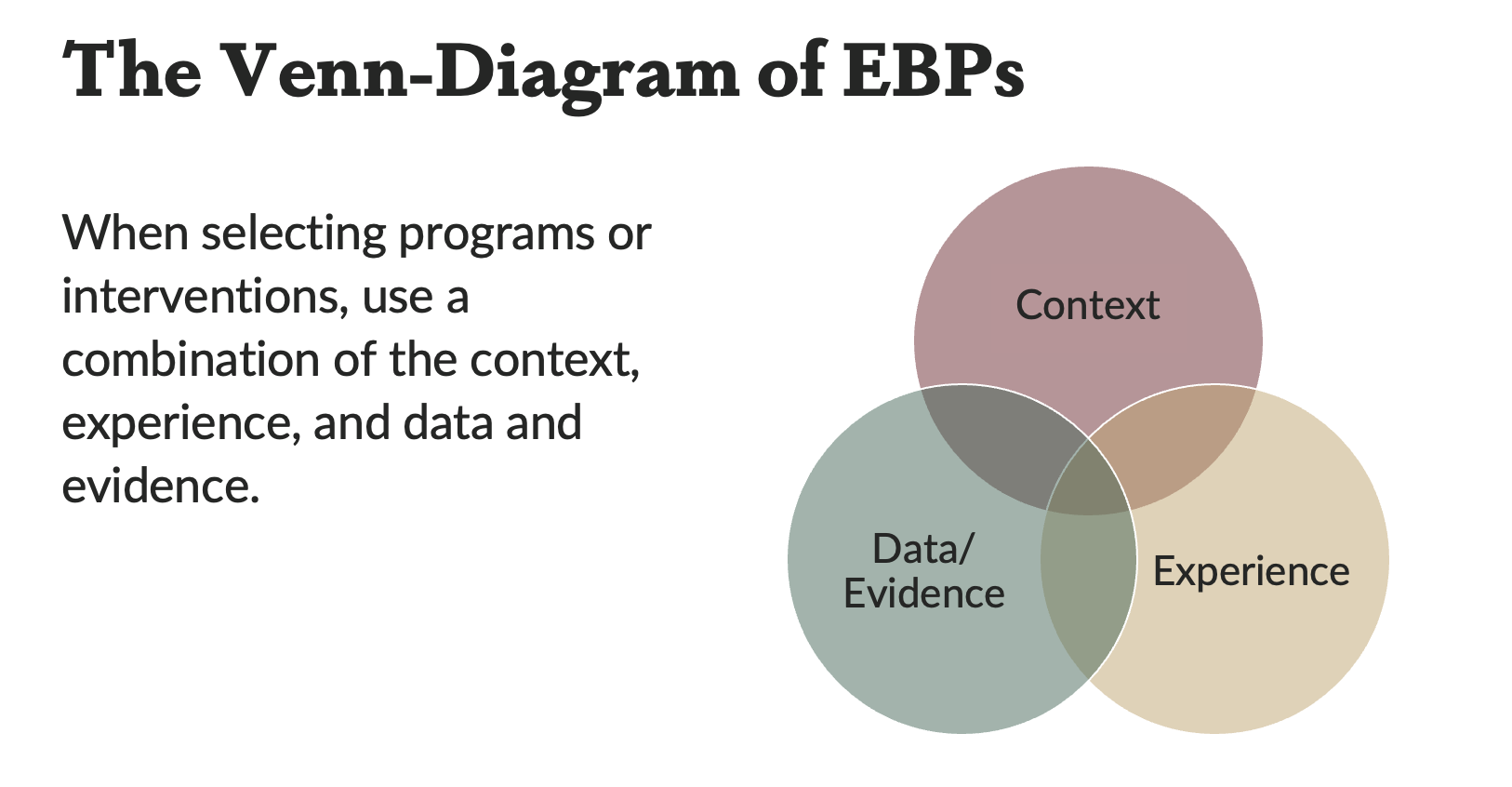
However, program selection typically involves more than identifying a well-supported model. Practitioners often weigh several considerations simultaneously. These include the characteristics of the population being served, the goals of the program, and the resources available for implementation.
For example, a program designed for suburban school settings may not translate directly into a rural community or an urban environment with different demographic and structural factors. Similarly, a program that requires extensive training or multi-session delivery may be difficult to sustain in organizations with limited staffing capacity.
These considerations do not diminish the value of evidence. Rather, they highlight the importance of interpreting evidence within a specific context.
The Role of Fit in Implementation
The concept of “fit” is frequently discussed in implementation science and refers to the degree to which a program aligns with the needs, culture, and resources of a particular setting (Durlak & DuPre, 2008). Research has consistently shown that implementation quality is a key determinant of program outcomes.
In practical terms, assessing fit involves examining several dimensions. Cultural relevance is one of the most important. Programs must resonate with the values, language, and experiences of participants in order to be effective. Capacity is another critical factor. Organizations need sufficient staffing, training, and infrastructure to deliver a program as intended. Alignment with organizational goals also plays a role, particularly when programs are integrated into broader prevention strategies.
These considerations are often informed by community needs assessments, which provide data on local conditions and priorities. When used effectively, these assessments can help guide program selection in a way that reflects both evidence and context.
Fidelity and Adaptation in Practice
Once a program is selected, attention shifts to implementation. A central issue in this phase is the balance between fidelity and adaptation.
Fidelity refers to delivering a program as it was originally designed and tested. This includes adhering to the structure, content, and sequencing of the intervention. Maintaining fidelity is important because it preserves the elements that were associated with positive outcomes in the original research.
At the same time, some level of adaptation is often necessary. Programs may need to be adjusted to fit scheduling constraints, cultural contexts, or participant needs. For example, facilitators may modify examples or language to make content more relevant, or adjust session timing to align with school schedules.
Implementation research suggests that outcomes are strongest when core program components are maintained, while peripheral elements are adapted as needed (Fixsen et al., 2005). This distinction is not always straightforward, and it often requires careful consideration and ongoing monitoring.
Why Local Evaluation Remains Important
Even when implementing a well-established program, local evaluation plays an important role. The original research provides evidence that a program can be effective under certain conditions. It does not guarantee that the same outcomes will occur in every setting.
Local evaluation helps organizations understand how a program is functioning in their specific context. This may include tracking participation and engagement, measuring changes in knowledge or behavior, and gathering qualitative feedback from participants.
Common approaches include pre-post surveys, which can capture changes over time, and qualitative methods such as focus groups or interviews, which provide insight into participant experiences. While these methods do not establish causality in the same way as RCTs (which for most organizations, is neither practical nor feasible), they are well-suited to the practical questions that organizations face during implementation.
Connecting Program Implementation to Broader Outcomes
Ultimately, the goal of selecting and implementing evidence-based practices is not only to deliver a program, but to achieve meaningful change. This involves connecting program activities to outcomes in a way that is both clear and measurable.
One way to think about this process is through a sequence that begins with defining what the program is intended to accomplish, followed by identifying indicators of change, and then using those indicators to communicate impact to drive funding. Here at Common Good Data, we call this the Clarity→Impact→Funding model.
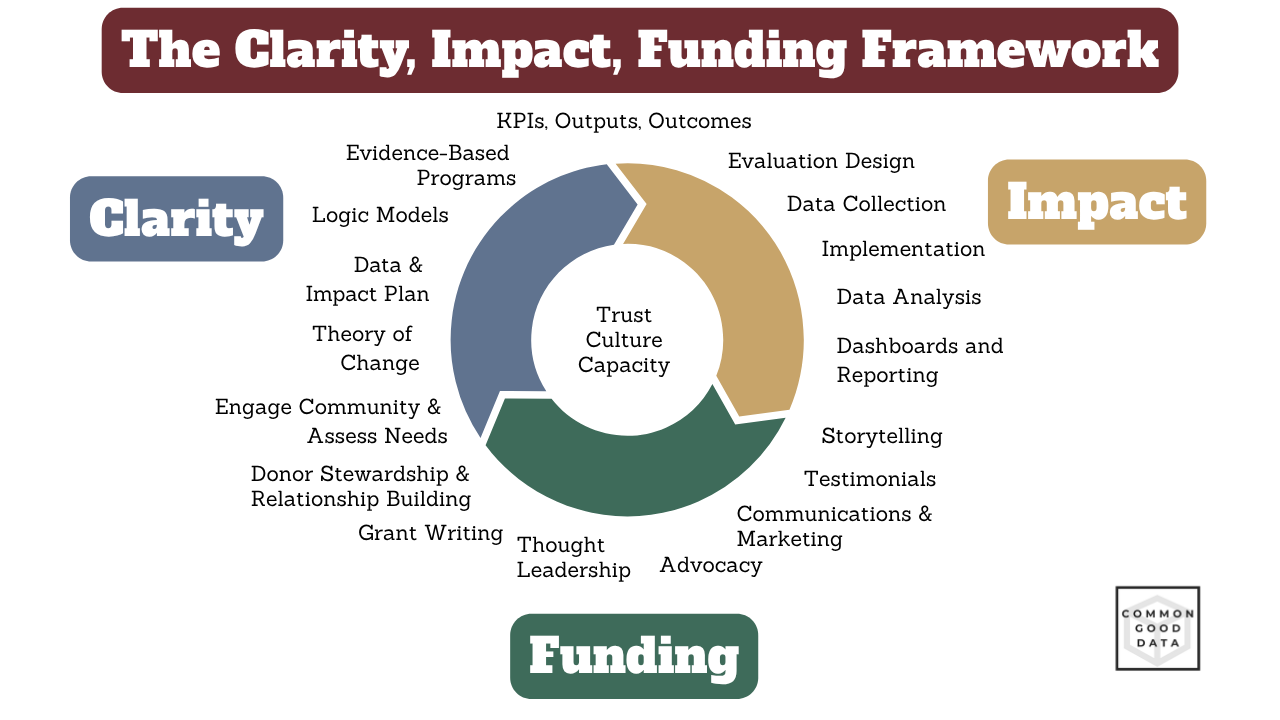
The Common Good Data Clarity→Impact→Funding Framework
In the context of prevention, this might involve linking a program designed to improve parent-child communication to measurable increases in conversations about substance use, and then connecting those changes to longer-term outcomes such as delayed initiation. With these outcomes demonstrated, organizations can then make the case to funders and community stakeholders for continued investment and support for the program.
Conclusion
Evidence-based practices provide an important foundation for prevention work. They offer a way to build on existing research and increase the likelihood of achieving positive outcomes.
At the same time, effective implementation requires attention to context, fit, and ongoing evaluation. Programs do not operate in isolation, and their impact is shaped by the environments in which they are delivered.
If your organization is looking for guidance on how to select, implement, and evaluate evidence-based programs, we’re here to help.
→ Contact us to set up a consultation and take the next step to becoming a more evidence-based, data informed organization!
→ Take our Behavioral Health Scorecard, a confidential 10 minute diagnostic for behavioral health leaders seeking to use data and evidence to secure and maintain state and federal funding.
References
Botvin, G. J., & Griffin, K. W. (2004). LifeSkills Training: Empirical findings and future directions.Journal of Primary Prevention.
Durlak, J. A., & DuPre, E. P. (2008). Implementation matters: A review of research. American Journal of Community Psychology.
Fixsen, D. L., et al. (2005). Implementation research: A synthesis of the literature.
Olds, D. L. (2006). The nurse–family partnership: An evidence‐based preventive intervention. Infant Mental Health Journal, 27(1), 5-25.
Petrosino, A., Turpin‐Petrosino, C., Hollis‐Peel, M. E., Lavenberg, J. G., & Cochrane Developmental, Psychosocial and Learning Problems Group. (2002). 'Scared Straight'and other juvenile awareness programs for preventing juvenile delinquency.Cochrane database of systematic reviews, 2002(2).
West, S. L., & O’Neal, K. K. (2004). Project DARE outcome effectiveness revisited.American journal of public health, 94(6), 1027-1029.