What is a Data and Impact Plan - and Do You Need One?
“Tell me about your outcomes.”
This is the question that causes many behavioral health leaders face to freeze. Shoot! you think. I know we’re doing great work, but I feel like we just can’t quantify it!
“We’ve got lots of data. I see the change in our youth every day - just come by and visit one of our programs, and you’ll see it too!”
You know it’s just an ok answer. When funders and other community partners experience and see your work, they’re more likely to get involved and support you. But you also know that this answer is probably not the best. And it’s leaving grant funds and donations on table.
I’ve seen this pattern in across organizations in behavioral health, substance use, and mental health. It’s hard to measure outcomes for human behavior - it’s not like bottom line revenue or taking your blood pressure. It’s measuring things like changes in attitudes, predicting behaviors, increasing confidence, and understanding mental health symptoms. These outcomes aren’t always easy to measure.
So even though your team works hard to collect data, complete reports, and meet funder expectations, when it’s time to explain the impact of your work, the conversation often becomes more difficult than expected.
What you need is a Data and Impact Plan.
A Plan to Solve Problems
Think of it as the bridge between your organization’s mission, the work happening on the ground, and the evidence needed to demonstrate results. Most behavioral health organizations already have pieces of this puzzle. They have strategic plans, grant requirements, surveys, reporting systems, and years of program experience. What is often missing is a single roadmap that brings everything together.
A strong Data & Impact Plan begins with the story your organization is trying to tell. It documents the challenge or community need you are addressing, supported by local data and evidence. It clarifies the outcomes your organization hopes to achieve and identifies how progress will be measured over time.
From there, the plan outlines the practical details of evaluation and data collection. What information will be collected? Who will collect it? How often? Will the organization rely on surveys, interviews, focus groups, administrative data, or a combination of methods? Which outcomes and key performance indicators will be tracked, and how will success be defined?
Just as importantly, a Data & Impact Plan establishes how information will be used. Data should support decisions, not simply satisfy reporting requirements. The plan identifies who is responsible for reviewing results, how findings will inform program improvements, and when data will be shared with leadership, staff, funders, and community stakeholders.
For organizations managing multiple grants or funding sources, the plan also creates alignment between evaluation activities and funder expectations. Outcomes can be mapped to existing reporting requirements while anticipating future funding opportunities, reducing duplication and helping organizations build a stronger case for support over time.
A Guiding Framework
When we develop Data & Impact Plans, we often find that organizations are trying to answer three fundamental questions.
The first is clarity. What change are we trying to create? This sounds simple, but it is often where organizations get stuck. Behavioral health organizations care deeply about improving lives, yet those aspirations need to be translated into specific, measurable outcomes. Reducing youth substance use, improving mental health symptoms, increasing recovery support engagement, or strengthening protective factors are all examples of outcomes that provide direction for programs and staff.
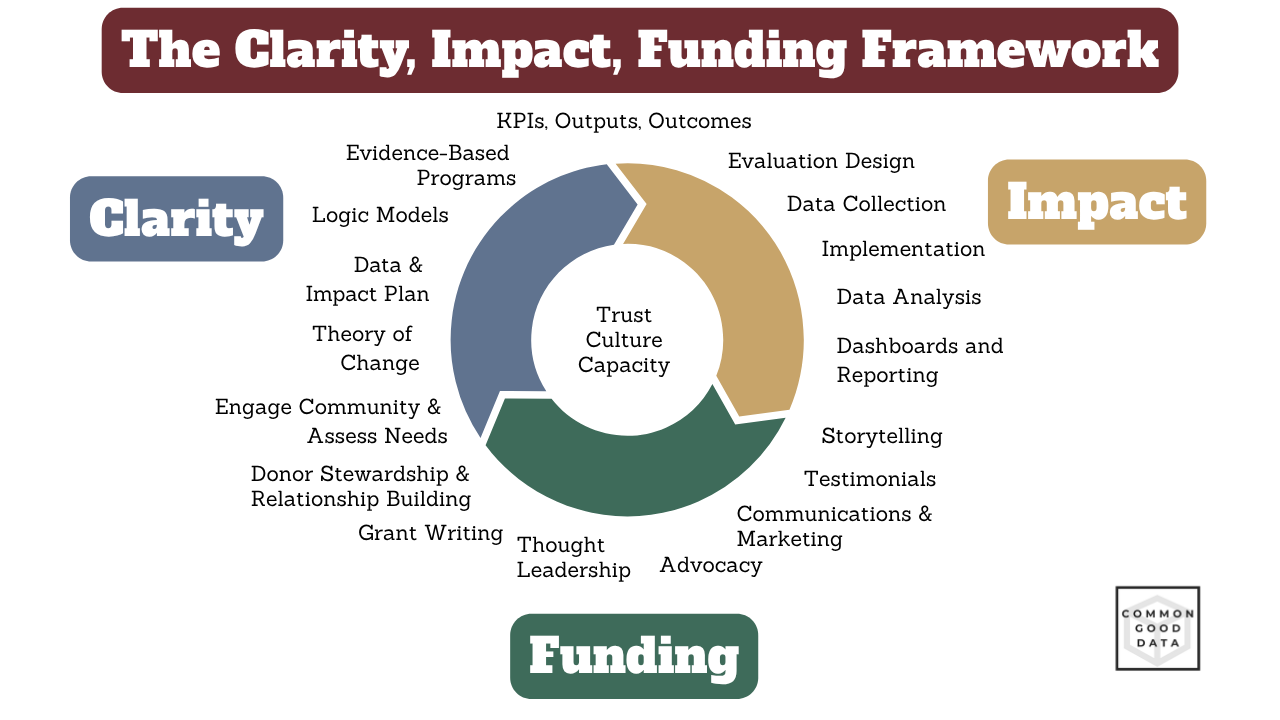
The Clarity→Impact→Funding Framework
Once those outcomes are clear, the next question becomes impact. How will we know whether change is occurring?
This is where evaluation and measurement come into focus. The goal is not to measure everything possible. Most organizations are already overwhelmed with reporting requirements and competing demands. The goal is to identify the measures that provide meaningful evidence of progress. Those measures might come from surveys, assessments, interviews, administrative data, or other sources, depending on the nature of the work.
The final question is funding. Why do these outcomes matter?
Funders, board members, and community partners are all trying to understand the value being created. They want to know how improved mental health outcomes reduce strain on crisis services. They want to understand how prevention efforts contribute to healthier schools and communities. They want evidence that investments are creating meaningful change.
A strong Data & Impact Plan connects all three. It creates clarity around intended outcomes, establishes a strategy for measuring impact, and helps organizations communicate the value of their work in ways that resonate with funders and stakeholders.
When those elements are aligned, reporting becomes easier, decision-making becomes more informed, and funding conversations become much stronger. Organizations spend less time searching for the right data and more time using it to tell a compelling story about the difference they are making.
Leading with Confidence
The next time someone asks, “Tell me about your outcomes,” imagine being able to answer with confidence.
Imagine your organization has a shared understanding of what success looks like, how it is measured, and why it matters. And you can state it with confidence.
That’s what a Data & Impact Plan ultimately provides. It creates alignment between strategy, programs, evaluation, and funding. It gives staff a common language for discussing outcomes. It helps leaders make more informed decisions. And it allows organizations to communicate their value more clearly to funders, community partners, and stakeholders.
The organizations that are most successful in securing support are often the ones that can clearly answer three questions:
What are we trying to change?
How do we know it is happening?
Why does it matter?
If you’re curious how your organization performs across those areas, start with our free Clarity, Impact, and Funding Scorecard.
In less than five minutes, you’ll receive a personalized assessment designed to help behavioral health organizations identify strengths, uncover gaps, and better understand where opportunities exist to strengthen impact measurement and funding positioning.
The insights may confirm what you’re already doing well. They may also reveal opportunities to strengthen the connection between your mission, your data, and the impact you create every day.
And if you’re looking for some help putting together a comprehensive Data and Impact Plan, reach out to us here at CGD - we’d be glad to help.