How to Break the Nonprofit Starvation Cycle
Listen to the Common Good Data Podcast on Apple Podcasts, Spotify, or YouTube.
Funders want proof that your programs are efficient and impactful.
But pulling together data to show your impact feels challenging when you don’t have the tools, systems, or extra staff to make it happen.
Your team is likely piecing together metrics with limited capacity, resulting in reports that fall short and reinforce the cycle of underfunding.
Today’s episode is about breaking that cycle.
We’ll show you how to make the most of data to create a roadmap that communicates your value and drives sustainable growth for your organization.
And we'll also talk about the tools and concepts that we cover in our upcoming online course, The Strategist.
Skip Ahead:
(04:26) Culture of data
(6:06) Assessing needs
(7:59) Impact plan
(10:46) Implementation
(12:20) Evaluation
(14:20) Organizational buy-in
Resources Mentioned
-
Drew Reynolds: [00:00:00] You know the pattern. Donors and funders want proof that your programs are efficient and making an impact, but you don't have the resources needed to invest in the administrative and overhead expenses that make this possible. And you also lack the resources to really invest in the kind of systems of data and evaluation that are essential to communicating the impact of your work.
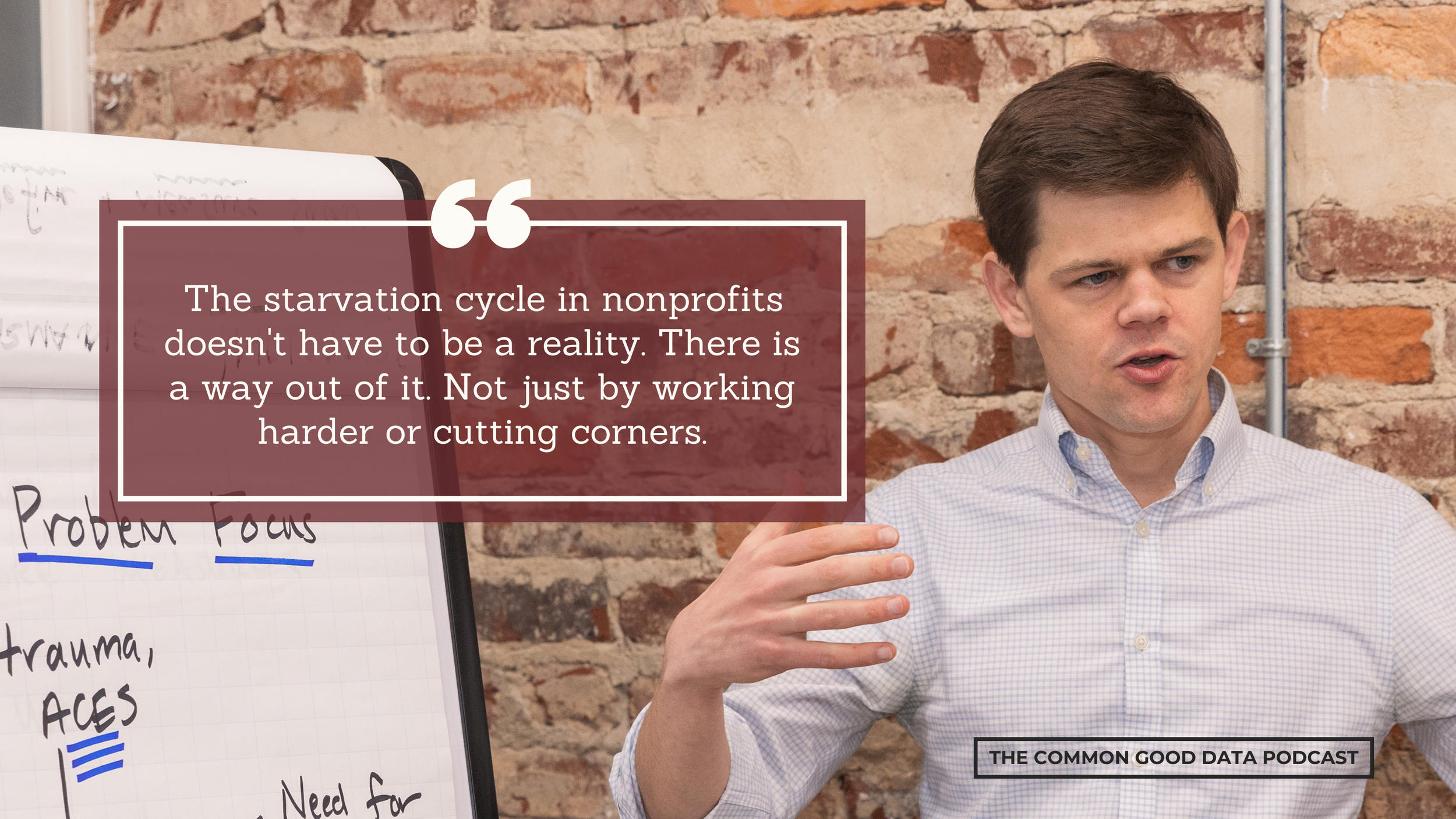
So, you cobble together what you can, maybe you stretch your already limited staff to track a few extra metrics, but it's never quite enough, and the results, underreported or poorly reported outcomes, lead to fewer resources and the cycle continues. But here's the thing, the starvation cycle in nonprofits doesn't have to be a reality.
There is a way out of it. And that way is through data strategy. Not just working harder or cutting corners, but working smarter and building a data strategy that proves your impact, that communicates your value and drives sustainable growth for your organization. And that's what today's episode is all about.
Drew Reynolds: We're going to explore what it means to [00:01:00] become the strategist. We had an episode, our last one that focused on kind of the characteristics or traits of a strategist, but today we're going to talk about what strategists do and strategists, these are leaders who use data to break free from that starvation cycle and create a roadmap for lasting impact.
And we'll also talk a little bit about the tools and concepts that we cover in our online course coming up, the strategists, and we'll have more details about that at the end of the episode and how you can start to apply them in your work right away. So let's get to it.
First, let's talk about what it really means to be a strategist. In nonprofits, we often think of strategy as something that happens once a year, maybe at a board retreat or at a planning session. But in reality, a strategist is much more than just a board meeting or a one time activity. It's something that is ongoing and going out throughout the year.
It also involves a shifting in mindset. Really, strategists are focusing on the big picture, right? So what is it that you're trying to accomplish on a larger scale? What problem are you trying to solve? And then in turn, how do you know that it's successful when you [00:02:00] have accomplished it? A strategist uses data to drive their decisions, not just a checkbox for funders, not filling out things or forms, but by generally understanding what's working and what's not, and where to focus your limited resources for the greatest impact.
And I'll tell you, here is the truth. Strategic thinking is the key to breaking free from the starvation cycle, right? Because when you can prove that impact, Clearly and consistently with data to back it up, you start to build trust with your funders. You make it easier for them to say yes to multi year commitments, and easier to win some of those higher dollar grants, um, uh, that have things like unrestricted funding or funding for administrative costs.
And, and just as importantly, you can strengthen your own ability to make informed decisions that align with your own mission and values. I was talking to a client the other day, and I asked him, why is it that you want to do this particular data and research study that he was proposing? And he looked at me and he said, you know, because I have seen what data can do to change narratives in my community.
I saw what another research study on opportunity did. He was referring to the Raj Chetty study on [00:03:00] on opportunity did to move this entire city into action. And I want our organization's story to be able to move people to take action on the values and mission that we care about. He said something to that effect, right?
And he gets it. Like nonprofits can really drive narratives when they're able to use data to tell a story. You can really start to change the narrative about how people are talking about a particular issue with that data and outcomes, uh, at your fingertips. I'll give you another example. So imagine you're leading like a youth development program and your funders want to know if your program is improving.
You know, youth outcomes, but you've been focused on tracking attendance and engagement. Things that you know are important, but they don't quite answer the funder's question or it's not quite complete enough or you're missing things. Now, a strategist would begin by saying, Hey, what's the core problem that we're addressing here?
Maybe it's a lack of access to academic support. And then they'd work backwards and they'd say, what are the outcomes? Do we expect to see if the program is successful and how do we measure those outcomes effectively? [00:04:00] So getting that clarity around what you're doing is going to help you tell your story to funders and also ensure that you're focusing your resources on the activities that truly make a difference.
So I give these examples about how you can approach this. You need probably a little bit more detail. So we're going to focus on five things that, um. Our, our, uh, strategists do to be able to accomplish this. Actually, I think I've got six here, so let's dive right into it. First, um, let's talk about a culture of data.
And I've talked about, uh, creating a data culture at your organization multiple times. You can check other podcast episodes on it, but it's so important to start with culture because. Without that culture, you're not going to have the kind of organizational buy in that's needed to be able to advance the work.
You know, nonprofit leaders will ask me, How do I know if my organization is ready for this or has the capacity for more of this data driven work? And it's a great question because building a data strategy isn't something about just having tools, another survey tool, or collecting numbers. It's really about creating a whole culture at your [00:05:00] organization where data and evaluation are a regular and natural part of the work that you do.
It becomes habitual. It becomes ritualized, as I often talk about. Strategists. A strategist is going to start by assessing their organization's readiness for a data driven culture. At the start, it means looking at things like, are your staff comfortable working with data? Are they trained appropriately to work with data?
Do you have routines or systems in place for collecting, analyzing and using data and in particular around privacy and confidentiality issues? Do you have some of those core pieces in place in your organization? And that also Do you have a shared understanding about why it even matters in the first place?
Because always that why is going to be what's driving the motivation behind your everyone from your direct staff up to your board members about using data and decision making. So from there, strategists are then going to work to integrate data into their organization's routines. And it doesn't mean just piling on more work to staff.
And hopefully if you're doing it right, it actually means less work. Um, But he means finding simple and effective ways to make data collection a part of everyday operations. Um, and you can find so many [00:06:00] different ways to do that. But without that culture, nothing else happens. So it's always important to start there.
Once you have that in place, the next big thing to ask is, what are these pressing needs in our community. And this is where we do something called a community needs assessment. And you may have done something like this in the past before, but it's so important to be always thinking about and responding to community needs as they change in your community.
Strategists are going to use this to paint a clear picture of the challenges and opportunities in their community. They're going to be incorporating qualitative and quantitative data, demographic trends, survey trends, but also focus groups and others to really understand what's going on. I'll give a good example of this.
I was working with, um, a drug free coalition called Alianza, and they wanted to learn more about their community and how they were thinking about prevention topics and what we were able to do was mobilize over 170 one on one interviews and conversations. And had community members document what they discussed.
And this was community members going out and having these conversations with other parents. [00:07:00] And this campaign led to some incredible clarity about what the community wanted. What they wanted was more programs for Latino youth and families that needed to be culturally sensitive, um, and linguistically responsive, i.
e. in Spanish, particularly for the parents. And since then, Alianza has delivered the evidence based program, Familia Adelante. It's a prevention program, and they've delivered it to over 140 parents and youth in just the last year alone. And they are on pace to deliver many more. So, why was this so successful?
Well, because they found out that the community wanted it, and they responded by delivering what the community wanted, and not some other program, or some other activity, or some other thing, that the community wasn't really interested in. So strategists don't stop at just identifying needs. They dig deeper.
They say, what's going on here? What is it that the community wants and how can we in turn design our activities, our programs, and to respond to those needs and challenges. And they use that information to prioritize where their organization can make the biggest impact. Now, once that's done, you've done some type of needs assessment.
You're [00:08:00] going to need to have some type of impact plan. I like to call, um, you know, you might hear the term logic models that come into play that common good data. I like to put together something called a data and impact plan, which includes a logic model, but it also includes all the other pieces that you need to make the logic model happen.
Like how you're going to collect data, what your evaluation plan is going to look like, et cetera. And if you're not familiar with these, um, think of a logic model or an impact plan is kind of like a road map for your program. It helps you map out what resources you have, what activities and programs are going to implement and then ultimately what outcomes you expect to see.
And typically it's in a short, middle and long term. So you can start to figure out exactly what it is you're doing, what you're measuring and how those things are all aligned together. Uh, that's an incredibly important concept. Uh, when you're doing an impact plan is having that alignment, uh, so that you're not measuring something that you're not going to have an impact on.
And you are measuring the things that you will. Here's the thing. A good plan is going to bring clarity, not just to you, but to your staff, your funders. And your stakeholders and answers questions [00:09:00] like, what are we trying to achieve? And how are we going to measure success? And how are we going to connect to this bigger picture that we know, uh, we're all striving towards in our organization.
So I'll give another example. Uh, I work with an organization called be BFIT big dreams, uh, to youth after school and summer program that fosters the physical, mental, and social development of youth. And, and BFIT has received some local funding to deliver these programs to youth, but needs more clarity or needed more clarity on how to measure their impacts.
And so. They could report back to their current funders, but also attract, you know, some of those new, bigger funding streams to provide the long term financial support for the work that's so essential to their program. So we put together an impact plan that will measure the changes in physical fitness, nutrition, and exercise.
It's going to track social development strategies in key and, sorry, um, social development changes and skill sets related to decision making, leadership, um, and also is going to track academic outcomes. And so, uh, this organization beef, it now has a clear data collection process and tools that's going to measure that impact and be able to show on a [00:10:00] semi annual and annual basis back to funders the impact that they're having on those indicators.
And without that clarity, you're going to get stuck. In reactive mode, you're putting out fires, you're, you're sending out random surveys, or you're, maybe you're doing a focus group here or there. You're trying to collect testimonials, but it's disorganized and it's not put together and it's not matching what your funders are requiring.
And it's not going to be able to attract those kinds of, uh, funders in the longterm that are going to provide that longterm support. So I give the example of beef it because of the, the, the methodical approach by which they said, Hey, we really know that data is going to be an important thing for us in our organization in the next couple of years.
Here's what we're going to do. To put our pieces in place to ensure that we're doing that data collection and gathering information that we're going to be able to need to demonstrate impact. Now, once you've got that plan in place, it's about time to implement. And that means that programs and activities are delivered and implemented as intended.
It's not just enough to have an impact plan or a logic model on paper, you have to actually make sure that it's delivered [00:11:00] in practice. So, for example, if your plan includes A mentoring program with weekly section, sorry, with weekly sessions, you know, a good strategist is going to come in and say, Hey, are these sessions actually happening?
Are the mentors showing up? Are the students engaged? Is this working the way we intended to work? And I'll be honest, this is where I see a lot of programs fail. They have great ideas on paper and a terrific logic model. And they may even have won a grant, but they fall short on the implementation aspect and things come up like recruiting participants into their programs, or maybe their staff aren't trained or they're just, they're not a good fit for the role and, and, and their people stop coming, right?
Uh, this is where building things like trust and relationships and regular engagement with your audience. It is so, so critical for the long term success of your program. And it might seem straightforward to just say, Hey, yeah, you gotta, you gotta implement your plan once you have it. I find that inexperienced professionals often fall short here.
And a strategist is going to be assured that they're on top of [00:12:00] implementation. They're checking in with their staff. They're bringing on expertise where needed to make sure that programs and activities that they planned are actually getting implemented. And I tell you, a good strategist holds a high bar.
For themselves and the people around them to make sure that these programs are done the way they are intended, because without that implementation, there's no point in collecting data because you're not going to have any impact. After that comes evaluation and good strategists evaluate their programs and their activities.
And here's what I love about evaluation. It's not just about demonstrating impact, though. You know, you have to do that, right? It's about constantly improving your work and good strategists really understand this. They understand that evaluation is a tool for learning and adapting and doing better over time.
You know, people are always talking about professional development, you know, for their, their staff and how they need to increase their capacity for skills and whatnot. I actually think a great professional development tool is already in your organization. And it's gathering data and asking questions and meeting as a group to talk about it and helping each other learn about [00:13:00] your own work and your own programs, because that's where the expertise lies.
That's ultimately going to make sure that your programs are having a big impact. So, um, that evaluation is so critical and, and it really depends on where you are. Some organizations are just starting out, right? And they might be conducting a small survey or just tracking attendance at their programs. Uh, maybe if you're getting a little more sophisticated, you've got pre post surveys in there, uh, and starting to do some focus groups or interviews.
And then if you're really on top of your game, maybe you're even going to include a control group in there. And you might do something like a randomized controlled trial, which And the evaluation world is really the gold standard of showing impact. It's okay. Where wherever you are is totally fine. And the key is to start where you are and then build from there.
You don't try to do everything at once. You try to take in a phased approach, scaling your evaluation efforts as the capacity grows. So that's a key thing for this is just to think about always building and taking the next next step in your evaluation journey and starting out small. [00:14:00] And as you build and get better and your processes are in place, you can start to tackle the bigger evaluation things like the randomized controlled trials, which I tell you, if you want to get some funder attention, you run a successful RCT and show some impacts, you'll, you'll get some attention because it doesn't happen very often.
And then we talked about this a little bit in the culture section, but the last thing I do want to focus on a little bit is organizational buy in. Um, it's, it's getting your organization around you and the people to buy into the work that you're trying to do. And data driven work really can't happen in a vacuum.
It requires the support and engagement of everyone in your organization, from frontline staff to the boards of directors. And so many projects have failed because leaders saw data as an add on thing. As a something that one or two people did without communicating to their organization that everyone has a role to play in data driven work.
So strategists are going to know how to bring people along and they're going to work with their organizational leaders to design programs and build out plans. They're going to [00:15:00] collaborate with direct staff to get their feedback and to ensure that data collection processes are manageable, meaningful, and done with fidelity.
And they're going to engage board members by sharing key performance indicators that connect to the organization's mission. and strategic goals. It's this ability to foster buy in that sets strategists apart from other leaders. They understand that success doesn't, isn't about having the right tools or the methods, but it's about creating alignment, shared purpose, having that shared why across your entire organization.
So let's recap, what does it take to be a good strategist? It's about building a culture of data. It's about using data to understand community needs or conducting a needs assessment. It's about creating plans like impact plans or logic models to address those needs. Then you're implementing it with fidelity, evaluating the programs with the most rigorous methodologies that you can do.
Um, it's already small, but getting bigger and then ultimately leading your organization. To buy into it and say, Hey, yes, this is something that I want to [00:16:00] be a part of. Um, these aren't just tasks and they're steps toward breaking free from that starvation cycle that I talked about at the top of this episode and creating real long and lasting impact.
Because once you develop these skill sets and conveniently, meaningfully communicate your impact with your data, you'll start to see the funding come in the door. And I mean the kind of funding that the six in that six or seven figure range or even more over multiple years with support for administrative work and evaluation work.
Investing in your data and evaluation strategy pays dividends. And I can say this because I've seen the results. In fact, in my own consulting practice, my clients have achieved, at least that I know of, over four and a half million in grant funds. Um, that I've directly helped them to acquire, and that doesn't even count the grants that they were one indirectly or that I don't know about.
They didn't tell me that they were applying for it, right? So I know that this number is even higher because they were using the data that we had talked about to apply for those grants. So this year in 2025, I encourage you to dive in and [00:17:00] develop those strategic skill sets and really level up your social sector lead leadership skills.
And so if this sounds exciting or interesting to you, I do have some exciting news. I am releasing an online course that focuses on all these skill sets and there's one going to be called specifically the strategist that's going to help you develop these skill sets that are so important to your leadership.
And so to learn more about that, go check out www.commongooddata.com/courses. We'll have all kinds of information there. You can sign up so that you can be first in line when the course is released. Um, and, and use that as kind of a, uh, an opportunity for you to level up in your leadership skills.
So I encourage you to check out that online course, and I'll have more information coming about that very soon. So stay tuned until then have a wonderful week ahead.