The Analyst: 6 Steps to Make Data Work for Your Mission
Listen to the Common Good Data Podcast on Apple Podcasts, Spotify, or YouTube.
In the nonprofit and social sector, data is everywhere—whether it’s survey responses, attendance records, financial data, or program outcomes.
But numbers alone don’t drive change. It’s how you interpret and apply them that makes the difference.
As part of a three-part series, we previously discussed the strategist, and now we’re focusing on the analyst—the person who turns data into clear insights that inform decisions.
While many people take on this role in an organization, it’s not always just the “data person.”
Anyone who interacts with data needs to embody the characteristics of an analyst to become a strong, data-driven leader.
Skip Ahead:
(02:06) Why it is worth analyzing your data well.
(03:47) Effective analysis always starts with this.
(04:59) How to understand key metrics and trends with a high school math background.
(06:38) Methods for those who’ve taken a statistics course.
(07:43) Communicate your findings effectively.
(11:18) Balance accuracy with action and avoid ‘analysis paralysis.’
-
Drew Reynolds: [00:00:00] Today, we are focusing on a topic that is at the heart of data driven decision making, and that is analysis, how we analyze data. Data of course is everywhere in the nonprofit and social sector, whether it's survey responses or attendance records, financial data, program outcomes.
It's all over the place, but numbers alone don't drive change. It's what you do with those numbers of course, that matters. So today we're going to talk a little bit about the role of the analyst. And as a part of a three part series, we talked about the strategist. This week, we're talking about the analyst which is the person who transforms data into meaningful insights.
That drive action. And so many people fulfill the role of analysts in an organization. It's not always just a data person, but it's really anybody who interacts with data needs to have some of these characteristics of the analyst to be a strong data driven leader.
Drew Reynolds: So imagine that you are working in a health organization, a community health organization, and you're running a wellness program for young [00:01:00] people. And you're collecting data on program participation. And you notice as you go halfway through the program that attendance all of a sudden starts to drop off.
And if you're checking that data on a regular basis you might recognize that there's a pattern and maybe you're doing it across three or four different ones. So it would be hard to see if you were doing just one at a time. Transportation may be the issue, right? Transportation issues are maybe the biggest barrier for participants and what could be causing the drop off.
in attendance. So with this insight, maybe you and partner with a local ride share service or find out some other way to have to solve that transportation problem that allows for your attendance to quickly rebound. So that's what analysis can do is when you're analyzing your data, particularly in real time, it allows you To examine what you're doing and then make changes to your programs and services to respond to emerging challenges and ultimately improve your service.
So it's not just about crunching numbers for crunching sake. It's really about using data to solve problems, [00:02:00] improve programs and make a greater impact on those communities that you serve. So what does it really mean to be an analyst in the nonprofit world? Again, analysts do more than just collect data.
They transform that data and information into insights that are used to make decisions. And that's I think one of the biggest misconceptions that people have about data and statistics and people who do that work is that sometimes we get so caught up in the visuals and the stats and we try to make sense of what those numbers are that we forget that the whole reason we're doing it.
And so that we can use that information to make better decisions. It means asking the right questions, identifying patterns and data, presenting findings in ways that are clear, that are compelling. It's about connecting dots between numbers that you're observing in your organization's core purpose and mission.
And I, I think that ultimately for organizations and for leaders we sometimes get caught in thinking of data as something we have to do for somebody else. So the idea is, Oh, I got to get this [00:03:00] report that a funder needs. I got to get back on a grant report. We're working on putting together our annual report and we need to have some data on this topic.
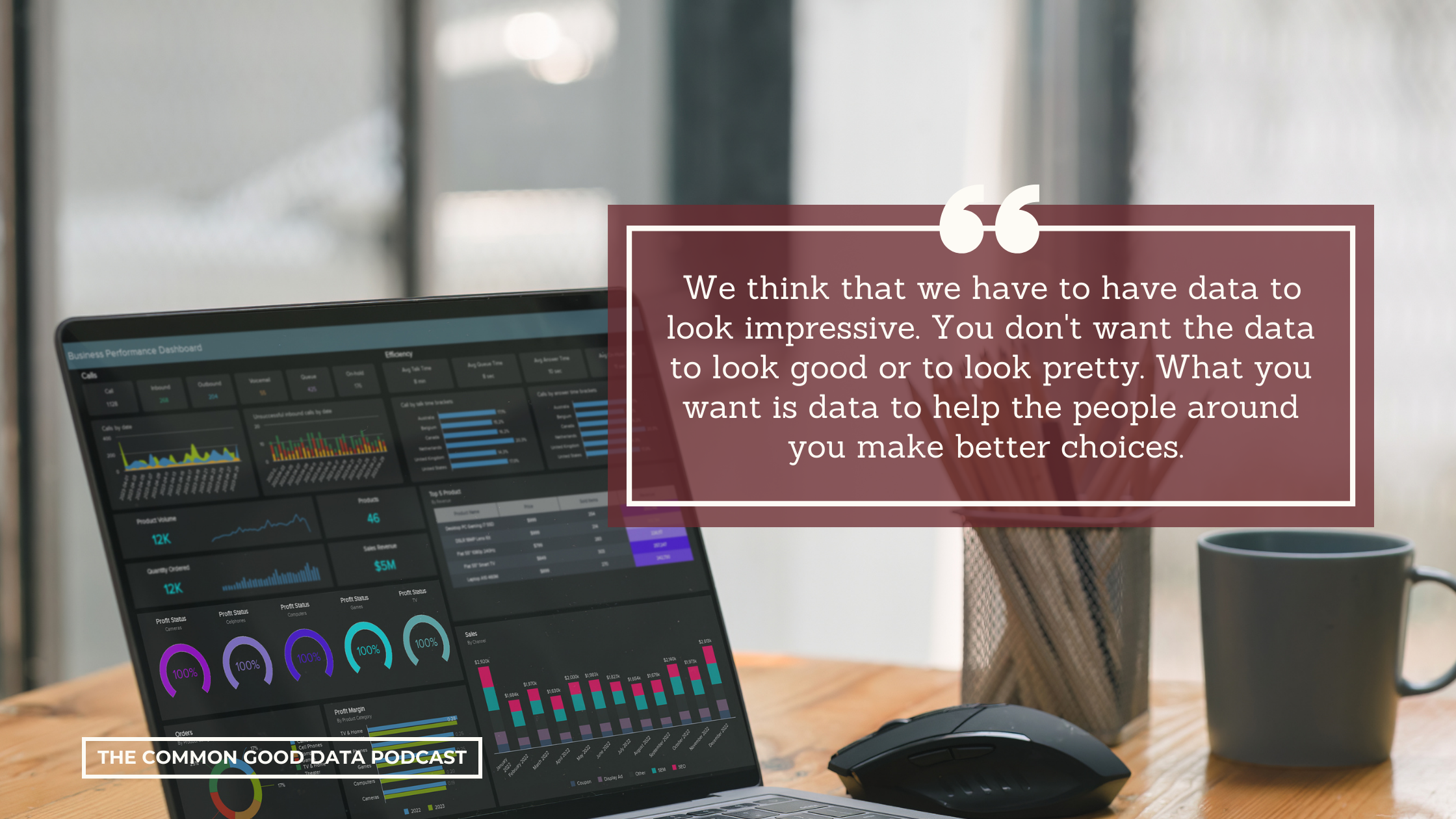
Whatever that may be. I'm going to go talk to my board. I need to share them something. And we just think that we just have to have the data to be able to look impressive and ultimately sometimes that works, but it's really not the best way to approach things. You don't want the data to look good or to look pretty.
What you want is data to help the people around you make better choices. Cause that's ultimately the whole purpose of why you do this work. Now, what do data analysts? What is it that they do that makes them effective at their work? So an analyst is good in, I would say four key areas.
And the first one is in data management. So it starts with being able to develop processes for collecting, cleaning, organizing data in a way that is easy to use and to analyze whether it's using tools like Excel or Google sheets or some type of more comprehensive database, good data management really is that foundation that is so needed.
For when you're going to [00:04:00] allow you to do the analysis work to make the good decisions. I think this is one of the areas that is actually one of the hardest to do and is where as a consultant I actually spend most of my time is how do we build out the forms the survey tools the back end databases the Spreadsheets to be able to collect the data in a systematic way that is then useful and easy to interpret For decision making so I recommend for those of you who might be new to the data management space to consider what are ways that you can improve your capacity, your organization's capacity to do this.
And whether that's investing in a new tool or rethinking how you're doing it, or maybe you're starting from scratch and it's Hey, I'm just going to start by getting some Excel sheets together. What is that next step that your organization can take with data management that allows you to be able to collect the information data you need to then do your analysis.
Now, once you have that data, a good analyst is then going to start describing the data or describing what's going on using the data is probably a better way to say it. And it involves understanding key metrics like [00:05:00] averages and percentages and trends. It's getting a picture of what's happening.
For example, maybe you're running a food assistance program. And you might track how many households you've served over the past this month and identify maybe changes or patterns in demand. Maybe things change around the holidays, for example, and it can help you prepare to make sure that you have the resources you need to meet those changes in demand.
Or maybe you're interested in the number of households that you serve that meet a particular criteria in this food assistance program. Whether or not the people you served are enrolled in SNAP, I think it would be really helpful to know, so that you could adjust your programs to maybe provide access to food and services that complement or go along with food that may come from the Supplemental Nutrition Assistance Program or SNAP.
Or maybe you're interested in just the demographic information about those you serve. Descriptive analysis takes this data and aggregates it using means, percentages, averages, charts, and graphics that can compare data over time or by subgroups. Now, the nice thing about descriptive analysis is that you [00:06:00] learned probably most of the math that you need for descriptive analysis in high school and most people did.
And so it's actually something that really anybody can do. It just takes a little bit of time getting used to maybe pointing and clicking in Excel a little bit, but it's something you can absolutely do. And it makes a huge impact on your ability to serve your organization. If you can start to do that well, now, the next step from that is getting into inferential statistics, and that gets a little bit trickier.
You might need to have had a couple of stats courses in college or grad school to be able to do this work well. But the idea behind inferential statistics is that it helps you dig a little bit deeper and will include some techniques, like hypothesis testing or statistical analysis to identify relationships between variables. So for example, you might analyze some survey data to see if participants who attended more program sessions report greater improvements, for example, in well being over time.
In one project I just finished for a client, we were able to show a statistically significant drop in stress. Experienced by the [00:07:00] adults in the program over time, and so that inferential statistics, it allows you to go beyond merely describing the data and look at relationships between variables and using probability, you're able to understand whether the likelihood of what you've observed in reality, like what happened in your program, whether that is likely to have occurred just due to chance or likely because maybe the program is having a big impact, right?
And that's what inferential statistics allows you to do. Now, of course, you can do all this analysis, but you've got to be able to communicate it. So one of the most important aspects of analysis is communicating your findings effectively. And any insights that you develop that aren't shared or understood by others, that doesn't change anything.
It doesn't lead to decision making. So it's critical to find ways to be presenting your information in ways that are clear and actionable and aligned with your goals. So I think a lot of times we think of visualizations using charts and graphs and tools like Excel or Tableau or Power BI to tell the story behind numbers.
[00:08:00] And those are great tools to use to be able to do that. But I think one of the most important things, not so much is the tool you use. but rather focusing on what is the key takeaway that your audience needs to have and understand to be able to make some type of decision. Rather than overwhelming people with too much information and detail.
How do you present your findings in a way that highlights what's important and how you should take action, I think is critical and such an important aspect of the work of an analyst that is often, I think, overlooked. I'll give an example of this. I'm presenting on the topic of opioid use for a client soon, and I have one graphic that shows a rise in opioid related deaths from overdose over time.
It's of course, very tragic. We're all very familiar with the opioid crisis in this country and the incredible harm that's caused in so many different communities. But what I think is interesting in these data is that it shows that overdoses in the community had started to peak around 2021, right in the middle of the pandemic and has started to go back down.
Now, it hasn't gone back down to where [00:09:00] things were before the opioid crisis, but it has started to decrease. And these graphics like these are so helpful in helping people understand and situate themselves within a broader narrative and story about what's going on, so we can understand, for example, that in a particular community, maybe things got really difficult and hard, but that improvements have been made that have helped to stem the tide a little bit of tragic loss to overdose.
So that some preventive strategies may be having some effect. But it also shows that there's a gap on what needs to be done because we're not back to where we were before this crisis began. And so it helps people galvanize and have a sense of energy and excitement around being able to try and reduce that number back to where you were before or eliminated altogether, right?
So having graphics can help tell these narratives and stories that help people situate where they are and what their next steps need to be. And a good analyst can understand exactly how to [00:10:00] use that data in a way to tell that story. Maybe I can share another practical example. So if you're a nonprofit focused on reducing homelessness, for example, and you discover that individuals who participate in job training programs are significantly more likely to secure stable housing within six months.
So job training programs, enrollment. Job training programs and enrollment is associated with secure, stable housing. The outcome, everybody who does work in housing wants to accomplish. So if you find that in your data and you share that insight with those funders, maybe that can help prioritize further resources to expanding those job training efforts.
And you are able to galvanize funding and resources to those because you know that is going to lead to that positive secure housing outcome. That's the goal for so many social organizations and non profit organizations is to be able to do that, to make that link between what you do and what your hope to achieve account outcome is.
One last thing I'll mention on analysis that is important to keep in mind is That [00:11:00] it's important to have the right mindset and to balance your accuracy and your data with action and what you're trying to accomplish. And I think a common pitfall that comes up with this is analysis paralysis. It's a term that comes up a lot where you're spending so much time analyzing data and looking at it this way or that way, or maybe you're putting together a report and you have a thousand charts instead of the two or three that are the most important and it makes it really difficult to take action because you've just.
inundated yourself with too much data, with too much information. And to avoid this, what you want to do is start with a clear question or hypothesis and then use that to guide your approach and analysis in the data. And I actually struggle with this a little bit because I always start with a hypothesis and then I go down a rabbit hole of exploring something else.
And then maybe something new emerges along the way. And I think it's okay as an analyst to allow yourself to do that. But what you don't want to do is to be so focus on analyzing every piece in [00:12:00] detail that you forget how to get to the most actionable and important parts of the analysis.
Now, a good example of this, for you all to think about, maybe you're trying to improve volunteer retention at your organization. And so you're thinking what are the factors that are most strongly associated with volunteer satisfaction? Use your analysis to identify those factors and then develop strategies to address them kind of focusing specifically on that aspect, rather than maybe all the information you have about your organization or about your volunteers can be a helpful way of narrowing your focus.
So to recap, let's talk about some key takeaways in the role of the analyst. One, analysts transform raw data into insights to drive action. Two, effective analysis starts with good data management and organization. Three, descriptive analysis. Helps you understand key metrics and trends. And I think everybody can do it or at least engage with it in some kind of way with a little bit of training.
Advanced analysis, inferential statistics is a little bit tougher. You might need to bring in an expert for that, but it can really reveal some of those deeper insights and relationships between variables like does program enrollment or activity [00:13:00] lead to some type of outcome that you're hoping to accomplish.
Then communicating findings using visualizations, things like Power BI, Tableau, Excel, and others to drive action and decision making is so critical and then always at the very end, number six, avoiding analysis paralysis and making sure you have that balance between Doing good analysis of your work, but also recognizing what is the most important thing we need to make decisions.
As we close out, here's my challenge for you. Take a moment to think about your own organization. What's an area where maybe better analysis could make a big difference. How can you use data to identify opportunities for improvement or drive decisions and make a bigger impact take some time this week to really think about that.
Data has the power to transform how we work and can change the work and the results that we accomplish. So when we use data to understand what's working, where we can improve and how we can make the biggest difference, we really become much more effective, more strategic and more impactful in our mission and essential as a leader to be able to have these skills.
Drew Reynolds: So thank you for tuning in to this episode of the common good data [00:14:00] podcast. This episode resonates with you, please do subscribe, share it with a colleague, leave us a review on Apple podcasts, check out our YouTube channel where you can get more great information like this, and of course, visit our website at commongooddata.com/podcasts and lastly, as we conclude our episode, I do want to take a brief moment to thank Jessica Whipple, who has been our producer for the past almost a year now. Jess work has really elevated our podcast, expanded our reach, and made for some great conversations on data and impact in the social sector.
This will be Jess last month working with us, so I wanted to take a brief moment to thank her for her service and exceptional work on this podcast. So thank you, Jess. Now, until next time, keep doing great work to use data to improve the well being of those you serve, and I'll see you all on the next episode.